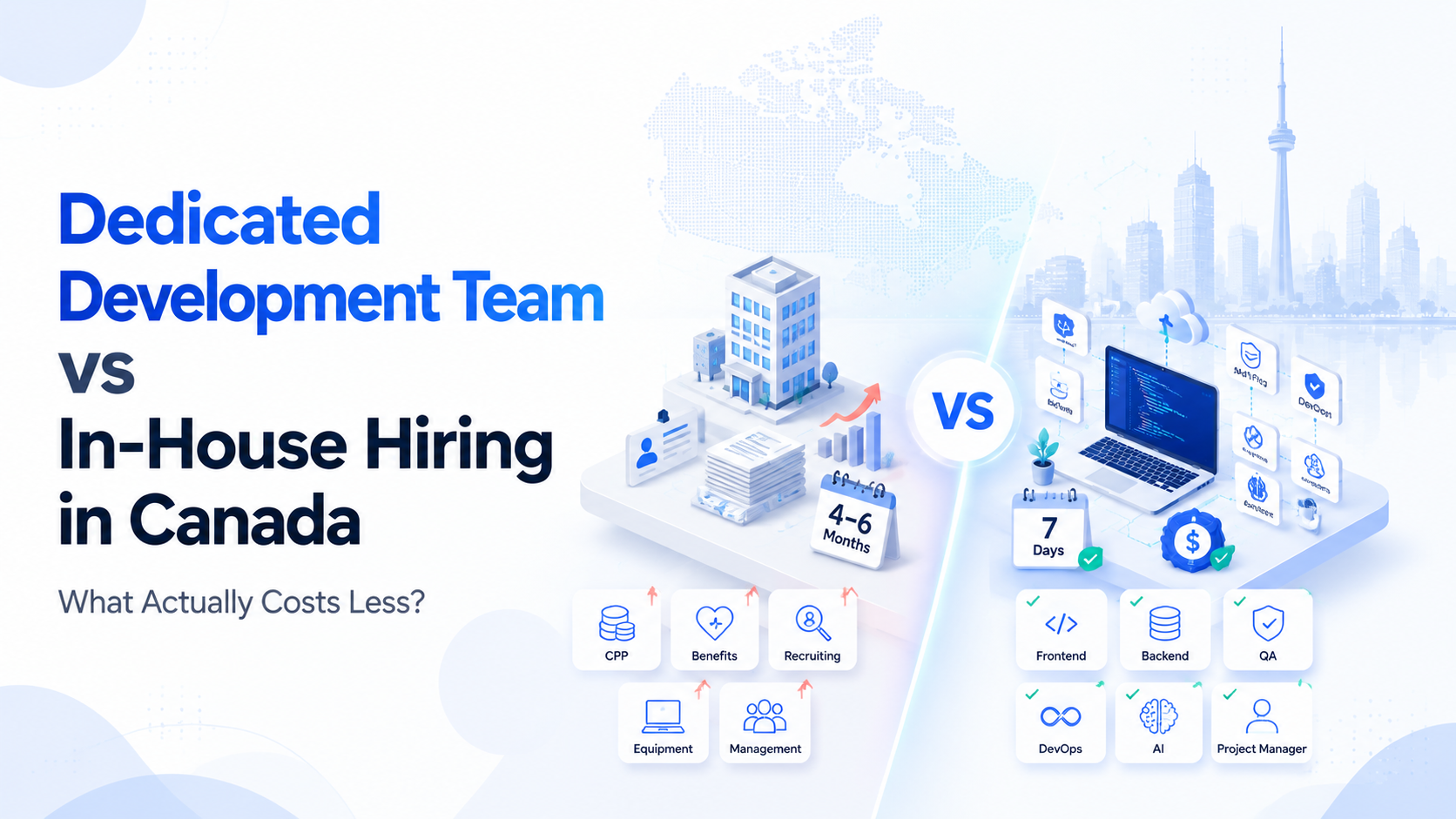

This post breaks down what in-house hiring actually costs for a Canadian startup in 2026, compares it to what a dedicated development team costs, and leaves you with a clear picture of which option makes sense depending on where you are.
What In-House Hiring Actually Costs in Canada
The number most founders anchor on is the salary. A senior developer in Canada commands between $120,000 and $160,000 CAD per year in 2026, depending on the province and specialization. That number feels manageable until you add what sits on top of it.

Mandatory Payroll Costs
Every Canadian employer pays a set of statutory contributions on top of gross salary. These are not optional and they add up fast.
- CPP (Canada Pension Plan): Employers match employee CPP contributions at 5.95% on pensionable earnings up to $74,600. The maximum employer CPP contribution for 2026 is $4,230.45 per employee, plus up to $416 in CPP2 contributions on higher earnings.
- EI (Employment Insurance): Employers pay EI at 1.4 times the employee rate. The maximum employer EI premium for 2026 is approximately $1,572 per employee.
- Workers’ Compensation: Varies by province and industry, typically 0.2% to 3.2% of payroll.
- Employer Health Tax: In Ontario, payrolls above $1 million trigger an additional 1.95% provincial health tax. British Columbia, Manitoba, and Newfoundland have similar levies.
For a developer earning $140,000 CAD, total employer payroll costs come to roughly $6,200 to $8,000 per year before you spend a dollar on anything else.
Benefits and Tools
Most competitive employers in Canada offer health, dental, and vision coverage. That adds roughly $3,000 to $6,000 per employee per year. Add equipment, software licenses, and development tools and you are looking at another $3,000 to $5,000 per hire.
Recruiting
Hiring a senior developer in Canada takes 4 to 6 months on average. If you use a recruiter, their fee is typically 15% to 20% of first-year salary, which comes to $21,000 to $32,000 for a $140,000 hire. If you hire in-house, you still spend dozens of hours on job posts, screening, interviews, and offers, and there is no guarantee the candidate accepts or works out.
Onboarding and Ramp Time
A new developer typically takes 4 to 8 weeks to become fully productive. During that window you are paying a full salary for partial output. For a $140,000 role, that is $11,000 to $22,000 in ramp cost before anything ships.
What a Three-Person In-House Team Actually Costs (Year 1)
Most startups need more than one developer. A realistic starter team includes a senior developer, a designer, and a project manager. Here is what Year 1 looks like:
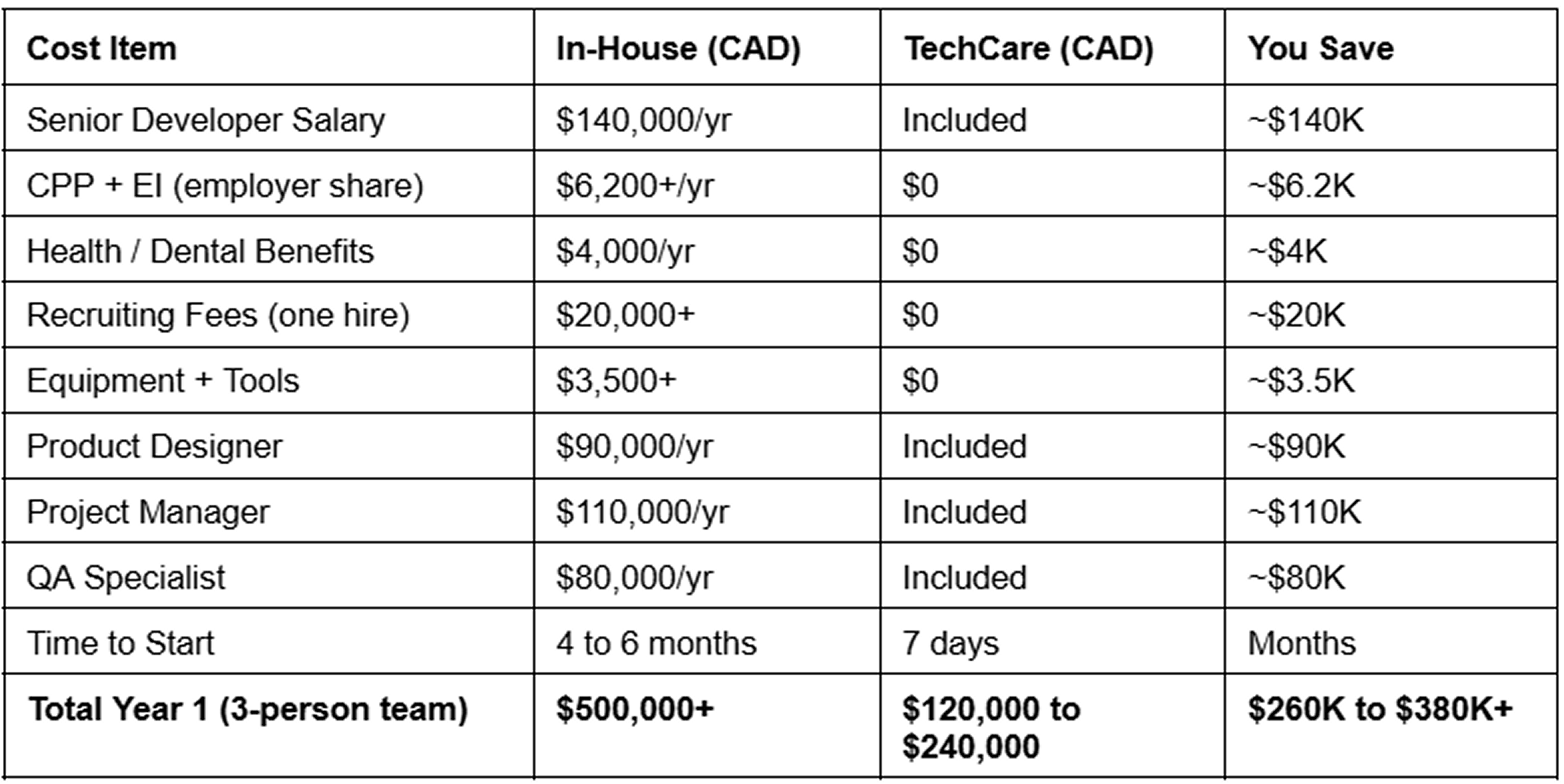
These numbers reflect CAD costs based on 2026 CRA payroll rates, publicly available Canadian salary data, and typical agency recruiting fees. They are conservative estimates. Real costs often run higher.
What a Dedicated Development Team Costs
A dedicated development team gives you the output of an in-house team without the hiring, the payroll admin, or the management overhead. The team works exclusively on your product, attends your standups, uses your tools, and operates like an extension of your company.
- The cost structure is simpler: a fixed monthly rate that covers all roles, no recruiting fees, no CPP, no EI, no benefits, no equipment, no ramp time.
- You get a team building inside 7 days, not 6 months.
To use TechCare as a real example:
- Launch Plan (1 Frontend Dev + 1 Backend Dev + PM + Designer + DevOps): from $10,000/mo CAD
- Growth Plan (adds QA Specialist + Technical PM + AI-Powered Dev): from $20,000/mo CAD
- Scale Plan (full team including Mobile Dev, DevOps Engineer, 2 Backend): from $50,000/mo CAD
- Year 1 cost at Growth level: $240,000 CAD, fully managed, no overhead.
- Comparable in-house team Year 1: $400,000 to $500,000+ CAD.
TechCare also qualifies for SR&ED and IRAP, two Canadian government programs that provide tax credits and grants for eligible tech development work. An in-house team can also qualify, but the administrative burden of claiming them falls on you. With TechCare, that structure is already in place.
The Hidden Cost Most Founders Miss: Management Time
In-house developers need managing. Sprint planning, code reviews, career development, performance conversations, and resolving blockers all land on you or your CTO. For an early-stage startup, this is time that should be going into the product and the customer.
A dedicated development team comes with a project manager included. Delivery, deadlines, and day-to-day team coordination are handled. You stay in the loop without being the one running it.
When In-House Hiring Makes More Sense
There are situations where building an in-house team is the right call. This post is not arguing against it as a concept.
- You have raised Series B or later and can absorb the full cost.
- Your product requires highly specialized IP that needs to stay entirely internal.
- You are past product-market fit and want deep institutional knowledge embedded in permanent employees.
- You have a CTO with capacity and experience to manage a growing team.
If you are pre-seed to Series A, have not yet found product-market fit, or cannot wait 4 to 6 months to start building, in-house hiring adds risk rather than removing it.
When a Dedicated Development Team Makes More Sense
A dedicated team gives you the most leverage when speed, flexibility, and cost control matter more than permanent headcount.
- You need to ship an MVP in 30 to 90 days.
- You cannot afford the 4 to 6 month wait to hire.
- You want to test product direction before locking in salaries.
- You need a full team (developer, designer, QA, PM) but cannot afford to hire each role separately.
- You want senior talent without senior overhead.
What to Look for in a Dedicated Development Team in Canada
Not all dedicated teams are built the same. Before signing with anyone, ask these questions:
- Do you own all code and IP from day one?
- Is the team dedicated to your project exclusively, or shared across multiple clients?
- Who manages delivery, and do you have direct access to the people building your product?
- Can you scale the team up or down as your needs change?
- Is the engagement month to month, or are there long-term lock-ins?
- Are they eligible for SR&ED or IRAP funding programs?
TechCare answers yes to all of the above. Teams are dedicated per project, clients connect directly with developers, and there is a 30-day free trial so you can test the team before committing to anything.
The Real Question
The decision between in-house and a dedicated development team is not really about preference. It is about what your runway allows and how fast you need to move.
For most Canadian startups in 2026, a dedicated development team costs less, starts faster, and carries less risk than building an in-house team from scratch. The numbers above are not estimates designed to make one option look better. They are real 2026 figures from CRA payroll data, Canadian salary benchmarks, and publicly available agency rates.
If you want to put an actual team behind your product without spending the next six months hiring for it, TechCare offers a 30-day free trial. Try a full team, see the work, and decide after.
Ready to skip the hiring process?
TechCare gives Canadian startups a full product team in 7 days. Engineers, designers, AI specialists, and a PM, all managed for you.
Try it free for 30 days at techcare.co