
This list breaks down five software development companies working in Canada right now: what each one is actually built for, and where each one falls short. Whether you’re a pre-seed founder or an enterprise buyer, you’ll find enough detail here to shortlist the right partner instead of guessing.
What to Look for in a Software Development Company in Canada
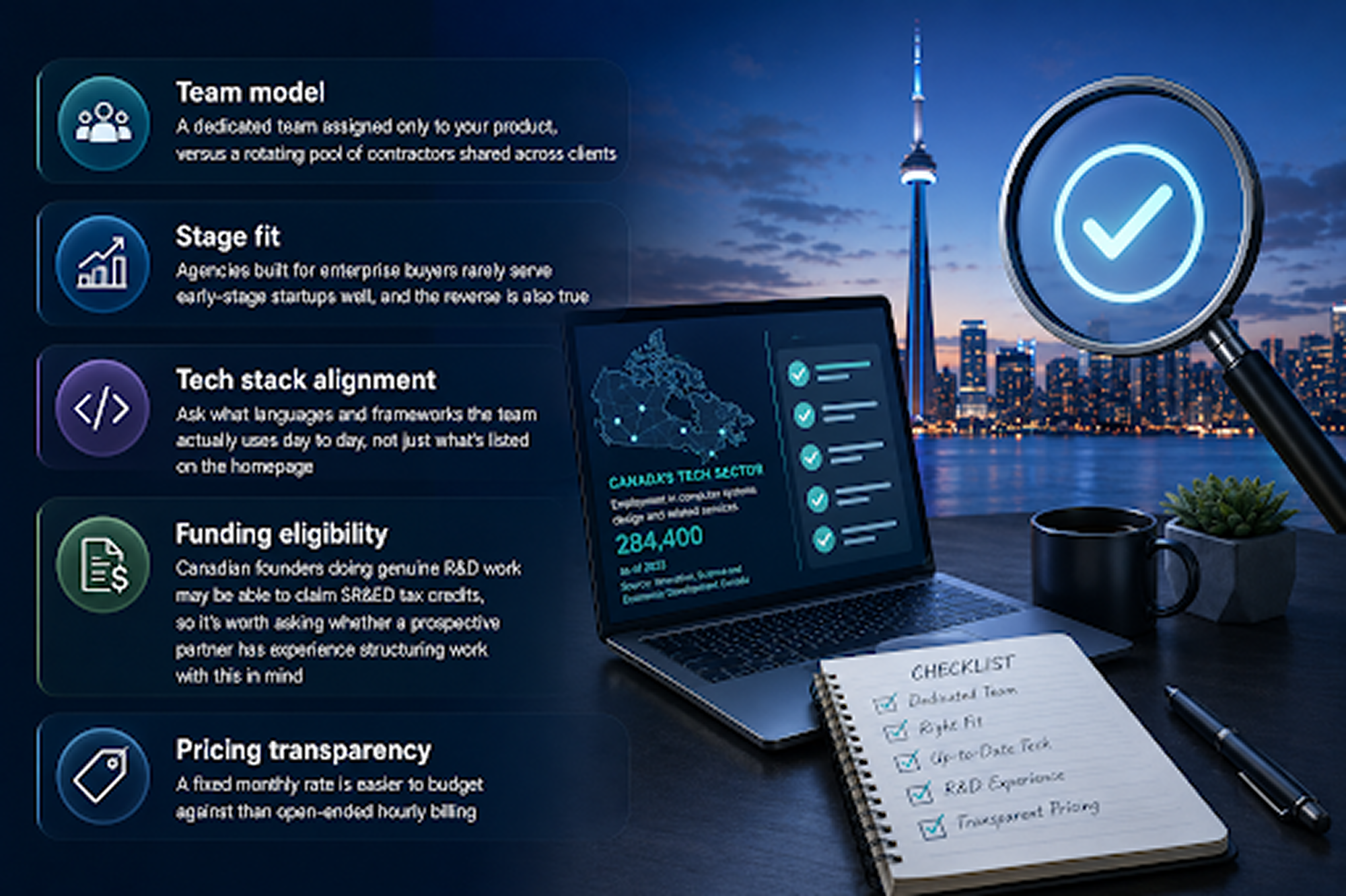
Not every dev shop operates the same way, and the differences matter more than most comparison pages let on. Before you sign anything, check for:
- Team model: a dedicated team assigned only to your product, versus a rotating pool of contractors shared across clients
- Stage fit: agencies built for enterprise buyers rarely serve early-stage startups well, and the reverse is also true
- Tech stack alignment: ask what languages and frameworks the team actually uses day to day, not just what’s listed on the homepage
- Funding eligibility: Canadian founders doing genuine R&D work may be able to claim SR&ED tax credits, so it’s worth asking whether a prospective partner has experience structuring work with this in mind
- Pricing transparency: a fixed monthly rate is easier to budget against than open-ended hourly billing
Canada’s tech sector isn’t short on options. Employment in computer systems design and related services alone was 284,400 people as of 2023, according to Innovation, Science and Economic Development Canada. The real challenge is narrowing that field down to a company that fits your stage and budget.
Why Custom Software Development Companies in Canada Make Sense for Startups
Off-the-shelf tools can get an idea off the ground, but they tend to break down once a product needs to scale or connect to something specific to your business. Custom software development companies in Canada build around your actual workflow instead of forcing you into someone else’s template, which starts to matter a lot more once you’re past the earliest version of your product and into real usage.
Top Software Development Companies in Canada
Here’s a breakdown of the best software development companies in Canada right now, ranked with what each one is actually good at rather than a generic pitch.
1. TechCare
Best for: Funded early-stage startups (pre-seed through Series B) that need a full product team instead of a single freelance developer
Key services: Dedicated product teams (engineers, designers, and project managers), AI-native software development, web and mobile app development, product strategy and design
Tech stack: Selected per product rather than a single fixed stack
What stands out: TechCare’s model is built around three things: working only with funded startups, using AI-native engineers who build with AI tools as part of the normal workflow, and giving every client a full team instead of a single contractor. New clients get a 30-day free trial before committing, and Canadian founders may also qualify for SR&ED and IRAP funding. TechCare has delivered 300+ products, reached 5M+ users, and holds a 5.0 rating on Clutch. See the full range of what the team covers on TechCare’s services page.
Potential limitations: Built for ongoing product development with a dedicated team, so it fits a founder building a real product better than a single short, one-off task.
2. Tech Mahindra
Best for: Enterprise clients in telecom, banking, and automotive that need large-scale IT services alongside software development
Key services: 5G and IoT solutions, enterprise mobility, cloud migration, digital transformation
Tech stack: Enterprise integration platforms suited to telecom, banking, and automotive systems, adjusted per client rather than one fixed stack
What stands out: Agile delivery paired with deep telecom and enterprise mobility experience, plus a track record of long-term enterprise partnerships
Potential limitations: Built more for large enterprise engagements than for early-stage startups looking for a small, dedicated team
3. Oracle Canada
Best for: Large organizations and government agencies running mission-critical enterprise software
Key services: ERP systems, database management, cloud applications, enterprise integration
Tech stack: Oracle’s own integrated stack, including Oracle Database and Oracle Cloud Infrastructure
What stands out: A long-established, dominant player in enterprise software with deep experience across finance, healthcare, and manufacturing
Potential limitations: Built for large-scale enterprise deployments, which usually means more overhead and less flexibility for startups that need to move fast
4. Digis
Best for: Growing startups that need flexible engineering capacity
Key services: Dedicated teams, SaaS development, AI solutions, web and mobile applications
Tech stack: React, Node.js, Python, Vue.js, AWS
What stands out: Flexible engagement structures and fast team scalability
Potential limitations: Less specialized in heavily regulated enterprise environments
5. MindSea
Best for: Companies building customer-facing mobile apps and digital health products
Key services: Mobile app development, custom software development, product strategy, UX/UI design, healthcare software solutions
Tech stack: Swift, Kotlin, React Native, Node.js, AWS
What stands out: Strong expertise in mobile product development, polished user experiences, and extensive work in healthcare and wellness apps
Potential limitations: More focused on digital products and mobile apps than large-scale enterprise systems
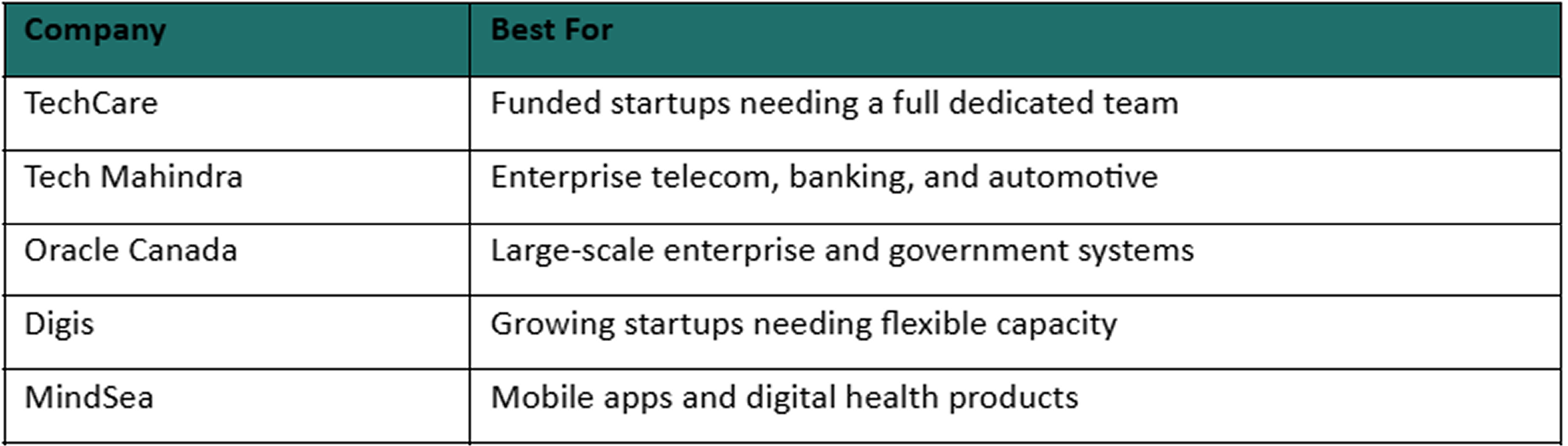
List of Software Development Companies in Canada at a Glance
How to Choose the Right Software Development Company for Your Project
There’s no universal “best” answer here, only the right fit for where your company is right now.
- If you’re funded and building your core product, look for a dedicated team model built around startups specifically, not an agency that treats you the same as a Fortune 500 account
- If you’re an enterprise buyer with compliance requirements, a larger established player with enterprise infrastructure will usually serve you better
- If your product lives mainly on mobile, prioritize a team with real depth in native mobile development over a generalist shop
- If your priorities shift often, look at flexible engagement models rather than fixed-scope contracts
Canadian venture activity is still active but more selective than it was a few years ago. CVCA reported close to $8 billion invested across roughly 570 deals in 2025, with the largest checks concentrated in fewer, later-stage rounds. If you’re an early-stage founder, that makes it worth choosing a partner who understands how to stretch runway rather than one built for a company that’s already raised a large round.
Final Thoughts
The right software development company in Canada depends far more on your stage and goals than on any single ranking. Enterprise buyers will find more value in Oracle’s or Tech Mahindra’s scale, mobile-first products may be better served by MindSea, and startups that need speed and flexibility have a strong case for Digis or TechCare.
If you’re a funded startup weighing your options, TechCare offers a 30-day free trial so you can see how a dedicated team actually works before committing to anything. Get in touch here.